
Let’s start with something important and often overlooked:
Many companies already operate with a composable ERP strategy — they just don’t call it that.
You run an ERP.
You add a few add-ons.
You integrate one or two external tools.
It evolves over time.
That’s composability in practice.
The confusion starts when terms begin to replace thinking.
1. First, let’s define the terms —
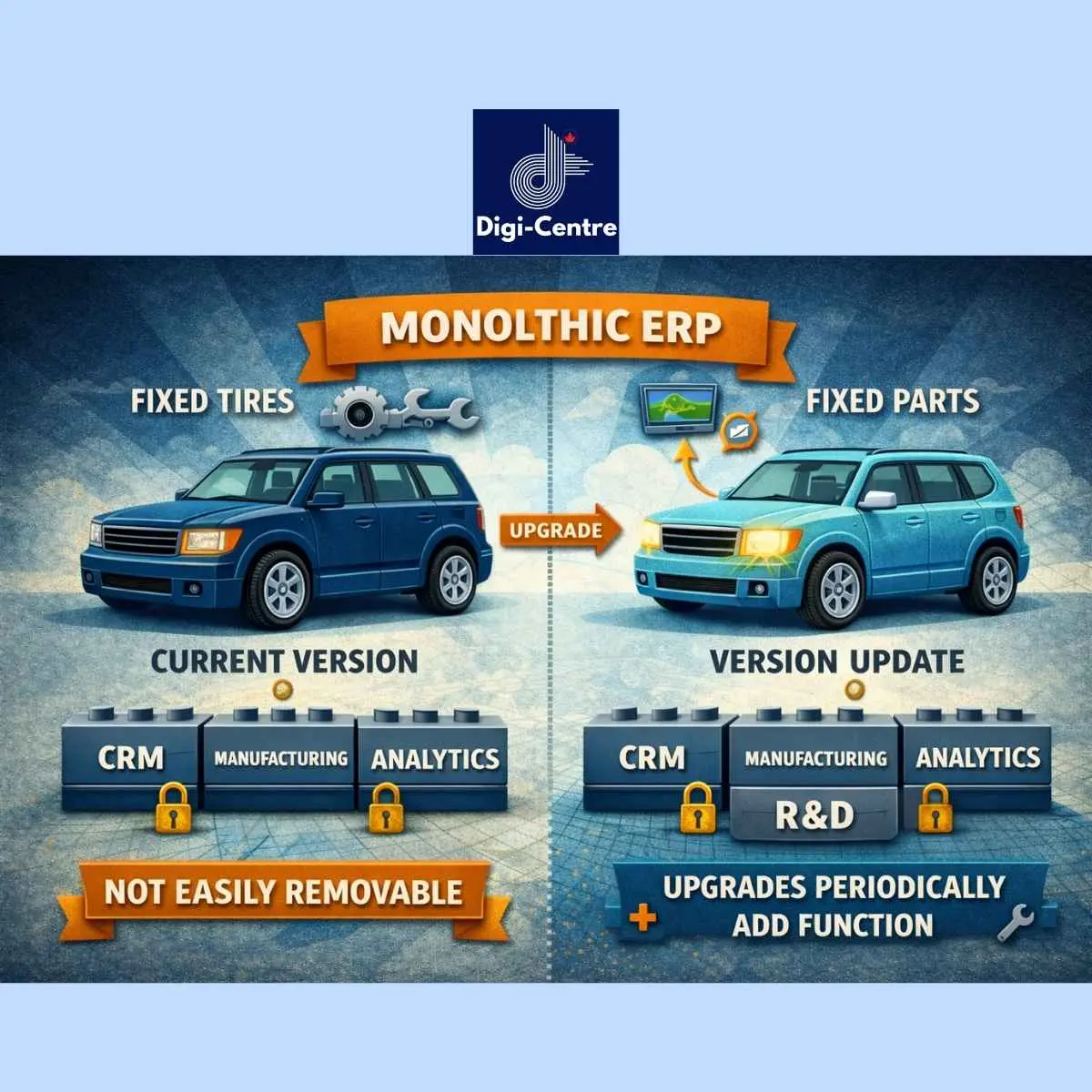
What people usually mean by Monolithic ERP
A monolithic ERP is typically described as:
- One core system
- One vendor
- Many functions tightly integrated (finance, inventory, sales, purchasing, manufacturing, reporting)
This is often presented negatively, as if “monolithic” automatically means rigid or outdated.
That’s not true.
A monolithic ERP is simply an integrated system designed to work as a whole.
Examples
- SAP ERP, where finance, inventory, purchasing, and sales share one data model
- Netsuite used with multiple native modules (Inventory, Accounting, Sales, Manufacturing)
- Genius ERP
Used properly, this integration is often a strength, not a weakness.
What people usually mean by Composable ERP
Composable ERP is commonly described as:
“Pick the best tools today, and swap or add others later as you grow.”
In theory, this sounds great.
In practice, this definition is incomplete.
True composability is not about features.
It is about architecture, data ownership, and roadmap discipline.
2. The LEGO myth — and why it causes bad decisions
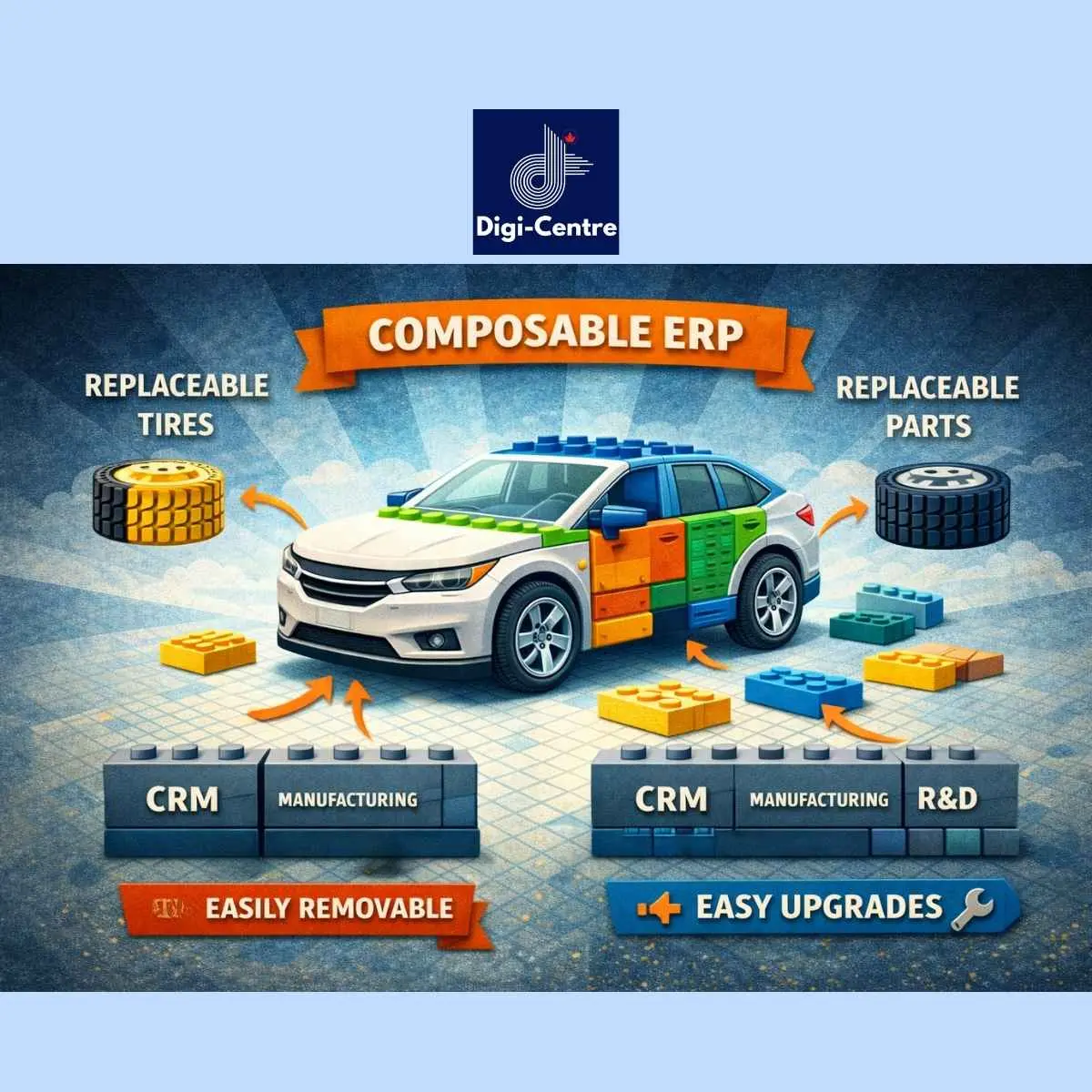
Composable ERP is often sold using a LEGO analogy:
“ERP systems are LEGO blocks. You can just replace one later.”
That analogy only works if all blocks are built to the same standard.
Enterprise software is not.
Two systems can both be “CRMs” and still be fundamentally different in:
- data structure
- workflows
- permissions
- reporting logic
- integration behavior
Replacing one is rarely a “swap.”
It’s usually a rebuild.
This is why many “best-of-breed” stacks quietly turn into:
- high integration costs
- reporting inconsistencies
- user frustration
- long-term consultant dependency
3. A more realistic analogy: the house you grow into
Buying a bigger house than you need
You buy a house with five rooms, but today you only need two.
At first, some rooms are unused.
Over time:
- one becomes a home office
- one becomes a library
- one becomes a gym
You didn’t replace the house.
You learned how to use it better.
ERP reality
Many organizations don’t use all ERP functionality simply because:
- they’re unaware of it
- they haven’t yet seen how it drives value
- their focus is on operations, not optimization
With time and curiosity, unused features can become powerful enablers.
Building with a strong foundation (platform strategy)
Alternatively, you:
- choose a solid foundation
- implement what you need now
- leave room to grow intentionally
This only works if:
- the platform supports growth
- expansion follows a roadmap
4. Important clarification: monolithic is not “bad”
This is where the debate often goes wrong.
Monolithic ERP is not bad per se.
It becomes problematic only when:
- it’s implemented without a roadmap
- everything is deployed “just in case”
- adoption is ignored
- the ERP is analysed in isolation
In reality, an ERP with add-ons is already less monolithic than it appears.
ERP + marketplace apps + integrations:
- is part of an ecosystem
- already supports a form of composability
- should be evaluated as a whole
Analysing the ERP alone often leads to the wrong conclusion.
5. Why a platform strategy matters more than the “monolithic vs composable” debate
The reason the monolithic vs composable ERP debate feels confusing is simple:
The market has already moved past it.
For years now, the real shift in enterprise software has not been toward “pure composability,” but toward enterprise platforms.
A platform strategy reflects how businesses actually operate:
- no single tool does everything perfectly,
- needs evolve,
- teams mature over time,
- and value often comes from how tools work together, not in isolation.
Microsoft, Zoho, and Odoo: platforms first
Modern systems like Microsoft Dynamics 365, Zoho, and Odoo are not just ERPs.
They are business platforms.
What that means in practice:
- A shared data model or tightly governed data layer
- Native integrations between applications
- Marketplaces for add-ons and extensions
- Workflow, automation, and reporting capabilities built around the core
- A design that supports phased adoption and evolution
In other words:
You are not choosing “a monolith” or “a composable ERP.”
You are choosing a foundation.
That foundation already assumes:
- extensions will exist,
- not everything will be used on day one,
- and value will increase as the organization matures.
This didn’t start yesterday — the platform shift has been underway for years
The move toward enterprise platforms is not new.
Some ERP developers and major players realized long ago that:
- businesses don’t operate in silos,
- they don’t replace systems lightly,
- and they benefit far more from ecosystems than from isolated tools.
That’s why platforms like Microsoft, Zoho, and Odoo took a different path early on.
- Microsoft built the Dynamics 365 family and the Power Platform to operate as a connected business ecosystem.
- Zoho was designed from day one as an integrated suite of applications meant to work together.
- Odoo was built as a modular platform; its CEO has often compared it to a smartphone app store — pick what you need, add more when it makes sense.
Other large vendors followed the same direction over time:
- some opened their infrastructure to third-party apps,
- others acquired complementary products,
- others built additional applications to extend their stack.
This is visible with players like SAP, NetSuite, Salesforce, HubSpot, and QuickBooks.
Why?
Because that’s how businesses actually work.
Businesses:
- combine finance, operations, sales, service, reporting, and automation,
- evolve unevenly over time,
- and rarely need “the best of everything” all at once.
Enterprise platforms exist because they reflect that reality — not because a new buzzword appeared.
The key insight: composable ERP is not new
This is the part that often gets lost:
Composable ERP is not a new invention.
What’s new is the label, not the idea.
Businesses have always:
- used an ERP,
- added surrounding tools,
- integrated what was missing,
- and evolved over time.
The difference today is that:
- platforms are more mature,
- integrations are more standardized,
- ecosystems are richer,
- and governance tools are stronger.
So when “composable ERP” is presented as something revolutionary, it’s often:
- consultants selling a term,
- rather than explaining the value that already exists in modern platforms.
Why a platform strategy is the right lens
Looking at ERP choices through a platform lens is more useful than debating monolithic vs composable because it forces better questions:
- What will be our system of record?
- How does data flow across the platform?
- What capabilities can we activate later without disruption?
- What belongs in the core vs the ecosystem?
- How does this support our roadmap over the next 2–3 years?
This shifts the conversation from:
“Is this ERP composable enough?”
to:
“Does this platform let us grow, learn, and adapt without constantly rebuilding?”
That’s the conversation that actually leads to good decisions.
The real takeaway
Composable ERP is not something consultants invented — and it’s not something you “buy.”
It’s a natural outcome of:
- choosing the right platform,
- implementing it pragmatically,
- extending it intentionally,
- and revisiting your roadmap regularly.
The danger is not monolithic systems.
The danger is letting terminology drive decisions instead of strategy.
Platforms like Microsoft, Zoho, and Odoo already give businesses what they need:
- a strong core,
- room to grow,
- and ecosystems that reflect how work really happens.
The rest is planning, governance, and discipline — not buzzwords.
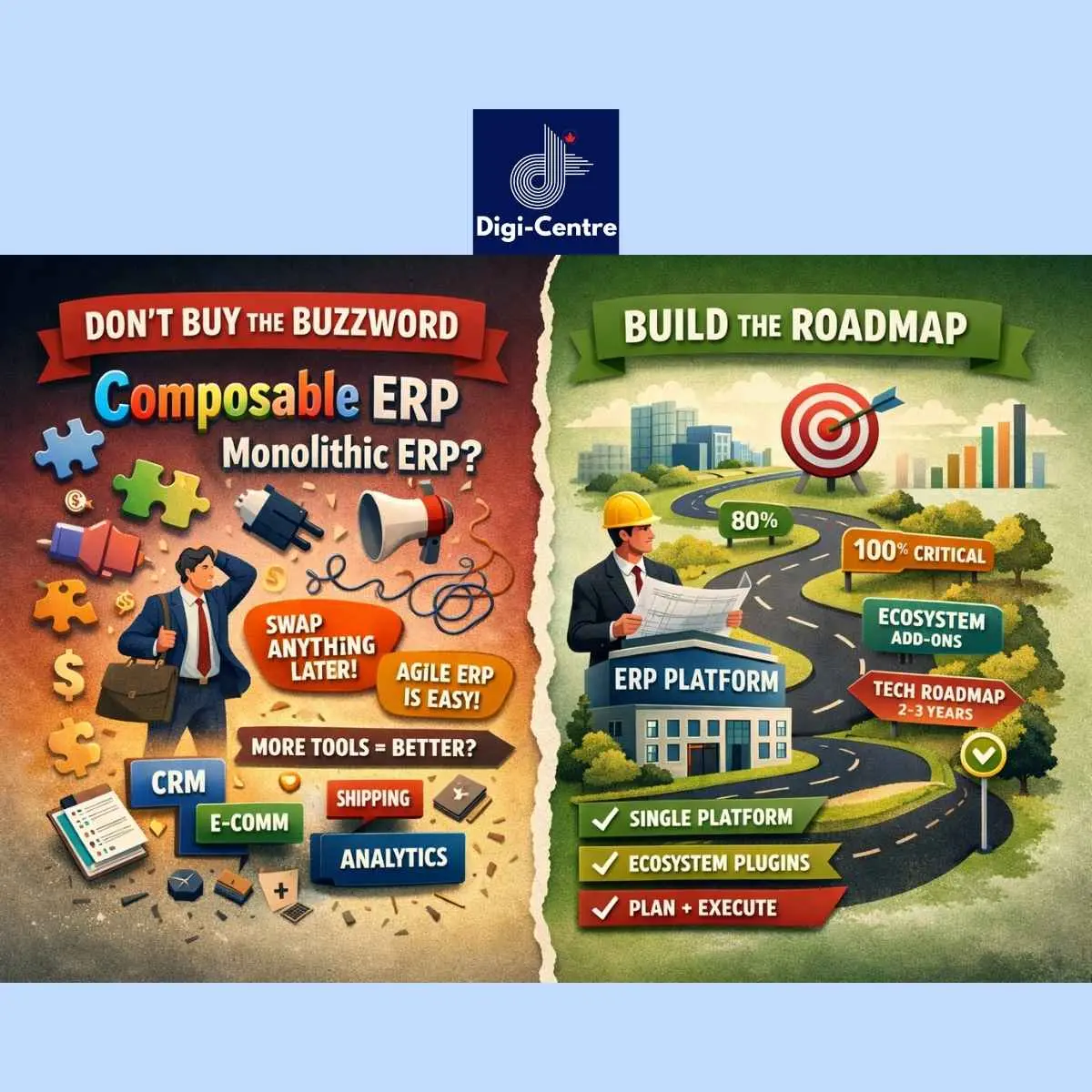
6. The Digi-Centre position: composability lives in the strategy
Our position is simple:
Composable ERP is not something you buy.
It’s something you plan.
A pragmatic, platform-first approach
- Select one best-fit ERP platform as your foundation
-
Ensure it covers:
- about 80% of overall needs
- 100% of your most critical, value-adding needs
- Use ecosystem add-ons where they truly add value
- Build a 2–3 year technology roadmap
- Revisit that roadmap every quarter
That’s real composability:
- sequencing instead of overload
- intention instead of buzzwords
- governance instead of chaos
7. Many companies already do this — without calling it “composable”
Common real-world setups:
- ERP + Shopify
- ERP + shipping software
- ERP + reporting tools
- ERP + industry-specific add-ons
That’s already a composable operating model.
What’s usually missing is clarity and ownership of the roadmap.
8. A quick word on buzzwords (Agile is the classic example)
Terms like composable or agile aren’t bad.
They spark learning and discussion.
The problem is how they’re used in sales.
There is no such thing as a fully “agile ERP implementation”:
- data migration
- accounting controls
- inventory reconciliation
- integrations
- cutover
These require structure.
Agile practices can help parts of an ERP project — but selling “agile ERP” as a cure-all is misleading.
Same issue. Different label.
Conclusion: focus on your roadmap, not the terminology
Monolithic vs composable is not a religious debate.
What really matters is:
- your business model
- your real priorities
- your team’s ability to adopt change
- your technology roadmap
Don’t let consultants drive the show with vocabulary.
Make them explain how the system supports your roadmap.
That’s how ERP decisions should be made.
Let’s make this simple
If all of this sounds familiar — or confusing — that’s normal.
Our role at Digi-Centre is to unpack the buzzwords, look at your reality, and help you end up with a system that actually works:
- for your team
- for your operations
- for where you’re going next
We’ll review:
- your current setup (or ideas)
- what actually matters in your business
- what you need now vs later
No pressure. No jargon.
Just a clear path to a system that fits.